
Related Stories



Share this article
What is Automated Integration REST API Testing
0
1
2
Before you dive in
Who this article is for — and why it matters
1Who is this article for?
QA teams at retailers running solutions with REST API integration.
2Background and context
With the growing adoption of SaaS ERP systems that utilize REST API integrations heavily, retailers face growing pressure from solution vendors to apply patches regularly - usually quarterly.
3The problem
Patch-related regression testing needs to happen multiple times a year, quickly and efficiently. One area that demands especially thorough regression testing is the REST API integration connecting the ERP system to external solutions through hundreds of REST API connections. Executing systematic tests for all REST APIs - with valid data, using both positive and negative test cases - effectively and quickly is crucial to ensuring upgrades and patches have no adverse effects on integrations with external systems via REST APIs.
4The solution
QBCS's automated REST API testing solution ensures quick, efficient, and systematic testing of all REST API integrations - including highlighting every detected change in the APIs following patching, across data structure, content, and functional behavior.
Beyond the 200 OK: Contract Testing for Retail's REST API Backbone
When testing REST APIs via execution, a successful response code doesn’t mean a successful transaction has been executed and completed. Here’s what retailers are missing and how QBCS closes the gap.
The Question Nobody Is Asking
Ask a retail IT team whether their integrations are working, and most will point to a dashboard full of green check marks: APIs responding, endpoints returning 200 OK – the standard HTTP status code that simply means “the request was received and handled without error” – uptime at 99.9%. It looks like proof. It isn’t.
A response code tells you a system answered the phone. It doesn’t tell you whether the message actually got where it needed to go, arrived intact, or triggered everything that was supposed to happen. In a modern retail architecture, that gap is where the real risk lives – and it’s invisible until an order goes missing, an allocation doesn’t ship, or a purchase order simply never shows up where the business expects it.
One Transaction, Many Ways to Fail
Consider something as ordinary as creating a shipment.
When an ERP system receives a shipment information via its REST APIs from shipping companies, the REST API is responsible for interpreting the message and its content, evaluate that the structure and content of the message is as expected and makes sense, and then perform a series of steps, based on the instructions in the message, and create relevant data in the ERP system.
Everything seems simple enough: Shipping information arrives, the REST API checks that it is the right format and content, then makes steps within the ERP system as instructed in the message – where could things go wrong.
Well, a specific example, that we have seen in the past, is when an external system sends a shipment update message to the ERP solution, which consumes and processes this message via its REST APIs. When the updated shipment does not exist in the retail ERP system, the REST API rejects the message with a business processing error, referring to the fact that the shipment being updated was not found. Integrations expect such a response in this case, and depend on this processing behavior. Until an upgrade changed the behavior of the REST API in the ERP system, which started creating shipments that were not found in the system when an update message arrived. Also a correct, but different behavior, which broke external integration since external systems expected no action to be taken by the ERP system in such cases.
This is one example where changes in REST API message processing behavior create problems in complex integration landscapes in ways that simple manual testing will likely miss – but systematic thorough positive and negative testing will catch this scenario and flag it for attention before it causes problems in production. A comprehensive, automated test suite will catch complex issues like this systematically, quickly and efficiently.
One transaction, many ways to fail
Anatomy of a Silent Break
A shipment update event looks identical whether it fully succeeds or quietly fails - every step below returns a healthy success response code while the transaction itself breaks.
Shipment update is processed
ERP REST API executes and returns a success return code for message processing status.
✓ 200 OK returnedProcessing behavior Primary
Injector service runs in retail ERP system and does not find shipment being updated, therefore creates the missing shipment.
External systems Silent failure
External systems and the business team assume that the shipment is not in the retail ERP system.
External systems Connected systems
Connected systems receive a shipment creation message from the retail ERP system.
Retail ERP reports Data integrity problem
Shipments that should not be in the retail ERP system now show up in reports and core transaction data.
Our Approach: Automated repeatable test execution
This is the problem our REST API testing framework was built to solve. Rather than validating a single hard coded request-response pair, we structure testing around the full lifecycle of a business transaction integration, with each step in the chain checked separately:
- Identify valid test data: As a first step, valid and repeatable test data is identified that produces both repeatable and comparable input data for REST API executions.
- Execute REST API: Using the data identified and gathered in step 1, execute the REST API being tested. Check the return code of the execution to detect technical issues.
- Verify execution result against expectation: Validate post REST API state by controlling data against test data passed to the REST API execution in step 2 above, to determine if the REST API processing behavior is as expected.
Chaining the above steps together turns a single pass/fail check into true contract testing: proof that a transaction was generated, processed and confirmed to make all changes in the ERP system running the REST API being tested as expected.
When one step fails, you know immediately if it’s a technical issue, a data problem or the processing behavior of the REST API is different than expected.
Our approach
Test the Whole Process, Not Just the Execution Call
One business transaction, executed via three independent steps — so a pass means the transaction actually succeeded in every way it needed to.
Identify test data
Identify valid test data the REST API execution will consume.
REST API Execution
Execute REST API with data from step one, confirm technical result of execution is as expected.
Verify changes made by REST API execution
Confirm the data impact of the REST API execution in the retail ERP system is as expected .
Built for How Retail Integrations Actually Behave
Retail integrations rarely fail cleanly, and our framework is designed around that reality rather than around a theoretical test environment:
- Test cases and test groups are reusable: defined once and reused indefinitely, with URL parameters and request payloads generated dynamically from live data – so a test suite doesn’t quietly go stale as your product catalog, order volumes, or item ranges change.
- Test cases can pass context to one another automatically, which matters when a downstream check depends on something the previous step produced – a timestamp, an identifier, an authentication header that needs refreshing before the next call goes out.
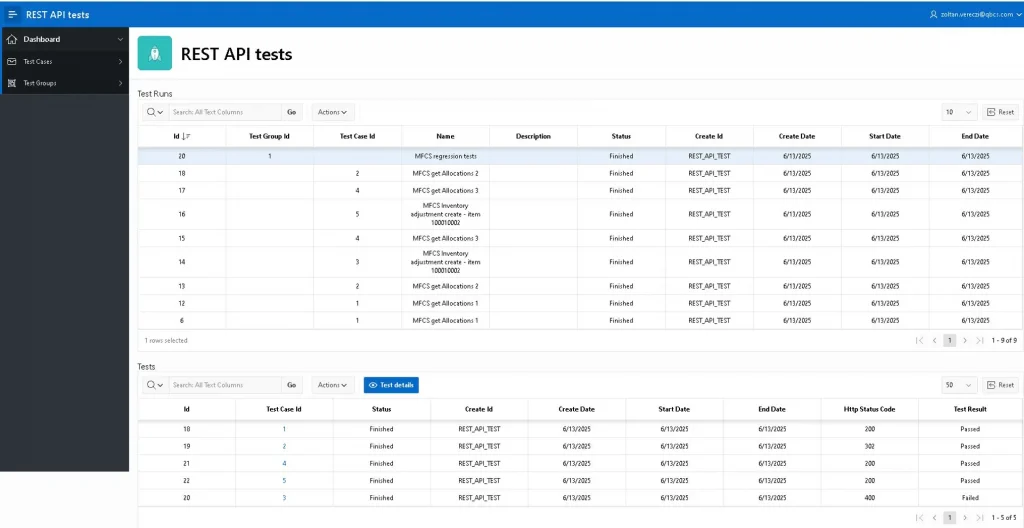
Every test run is logged and auditable from a central dashboard, so a failed validation isn’t just a red flag – it’s a record of exactly which test, which run, and which system was involved, available on demand rather than buried in a log file.
And because the whole framework is exposed through its own REST services, test cases and test groups can be triggered remotely, from a CI/CD pipeline, a scheduled job, or the AI-driven orchestration layer we’ve built for broader regression testing instead of living as a manual, click-through exercise that only runs when someone remembers to.
Since test runs are logged and archived with all relevant data, an extensively detailed run comparison capability gives you the ability to compare differences between runs of the same test cases, identifying changes in behavior introduced by patching, making the QBCS automated testing framework an ideal tool for regression testing to detect regression issues caused by upgrades and patches.
Why This Matters to Your Business
For retailers integrating complex multi-system landscapes via REST APIs, the payoff is concrete:
- You catch the failures that response codes hide. Context level testing surfaces the silent breaks – the changes in behavior, changes in content handling, data impact in the ERP system – before a customer or team member does.
- Root cause is clear, not requiring forensics to identify. Because each step of a test execution is validated independently, a failure points straight to the detailed problem source instead of triggering a multi-team investigation.
- Test coverage grows with you. The same test case and test group model that validates a single PO flow extends cleanly to allocations, transfers, inventory adjustments, and sales – any flow that touches integration REST APIs.
- It’s proven fast and thorough, not theoretical. We took a pilot test automation from concept to a fully working test suite in three months, running 500+ test executions in hours that used to take weeks – with room to extend coverage as new flows are added.
- A must for regression tests. With powerful test execution comparison capabilities, the test execution framework is an ideal tool for detecting regression issues caused by patches and upgrades.
Why this matters
Proven, Not Theoretical
Results from taking a pilot integration flow test from conception to a fully working, production-ready REST API test suite.
3 mo.
Pilot to production
Time to take integration flow test from conception to a fully working, running test suite.
Hours
Not weeks, per cycle
Full regression test executions that used to take weeks now complete in hours, enabling pre/post comparison.
3 hops
Verified per transaction
Identify test data, execute REST API, and verify result, - each checked independently, every run.
The Bottom Line
When testing integration REST APIs, a green check mark on an API call is a start, not a finish line.
The only way to know a REST API is processing data as expected is to test for complex behavior in addition to simple data format and content testing at scale and with speed.
That’s the gap our REST API testing framework was built to close. With over 500 pre-built REST API test cases, your QA team has a head start on test coverage and execution at scale. Contact us for references.

If your team is relying on “it returned 200” as proof that your integration REST APIs work, reach out to us. We’re happy to walk through how our automated testing framework will make delivering on your QA responsibilities a breeze.