
Related Stories


Share this article
The Retailer’s Quarterly Dilemma
For retailers on the Oracle Retail Cloud, the mandatory quarterly patch cycle is often a highstakes “fire drill.” Four times a year, Oracle pushes updates to every cloud tenant, forcing QA teams into a frantic “crossed fingers” approach. The question is always the same: Did the update break a critical business flow?
Traditionally, answering this requires a full sprint’s worth of manual testing or the
maintenance of brittle scripts that crumble under the weight of complex dependencies.
Modern retail backends are not monoliths; a single allocation test must traverse third-party event streaming platforms, pipeline orchestrators like Apache Airflow, Mulesoft and Oracle’s own REST APIs. Without automation, error diagnosis becomes a “forensic exercise” across multiple logs, and teams are trapped in a cycle of mechanical re-execution rather than highvalue exploratory testing.
Introducing the QBCS AI Regression Test Automation Tool
QBCS has revolutionized this process with a visual, AI-augmented orchestration layer built on the n8n platform. By replacing “script-tangles” with visual, node-based workflows, we provide living flowcharts that act as the single source of truth for your testing logic.
Designed for the complex Oracle ecosystem, the tool is self-hostable, API-first, and
integrates directly with RDS (Retail Data Store) and DAS (Data Access Schema). It
leverages RDS custom REST APIs to generate precise test data templates, ensuring that your test environment perfectly mirrors production schemas before a single message is sent.
The 5-Step Automated Test Lifecycle
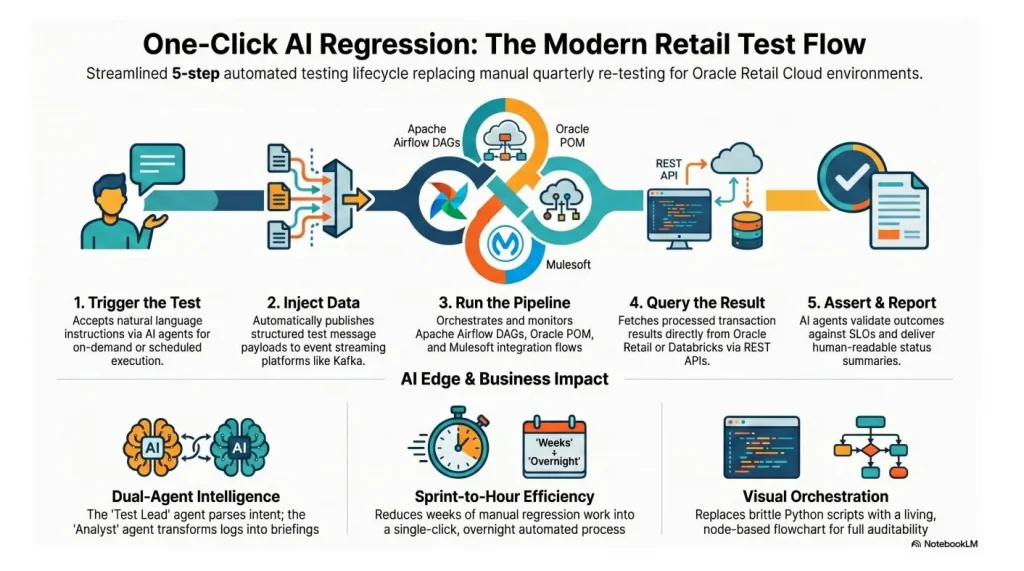
The 5-Step Automated Test Lifecycle The QBCS blueprint standardizes testing into five discrete, visible legs on the n8n canvas, providing total transparency from data injection to final assertion:
- STEP 01: Trigger the Test: Initiate tests on-demand or via schedules. Technical teams can use the AI agent to interpret natural language instructions into test parameters.
- STEP 02: Inject Data: The tool publishes structured tXML or JSON payloads** ready to consume. This simulates real-world activity, such as warehouse shipments or store receipts, at the messaging layer.
- STEP 03: Run the Pipeline: The workflow triggers external orchestration tools if needed like Apache Airflow, Mulesoft or POM (Process Orchestration and Monitoring). It doesn’t just “fire and forget”—it polls for status and monitors XCom values to ensure transformation logic has moved data successfully.
- STEP 04: Query the Result: Using DAS synchronization and MFCS REST APIs, the
tool fetches the processed business results directly from the Oracle Merchandising
Foundation Cloud Service. - STEP 05: Assert & Report: AI agents validate the actual business outcome against expectations, performing the “heavy lifting” of data comparison.
The Power of AI Agents: Test Lead vs. Analyst
We embed two distinct AI roles to move your team away from manual log-sifting and toward strategic decision-making.
Agent 1 – The Test Lead (QA Orchestrator)
The Test Lead acts as the intelligent entry point. It parses natural language (e.g., “Run a stress test on allocation creation with 1,000 items”) and converts it into a structured JSON payload. This allows non-developers to trigger complex integration tests without touching a line of code or an API client.
Agent 2 – The Analyst
The Analyst transforms raw JSON logs and system responses into human-readable decision reports. It focuses on SLO (Service Level Objective) compliance, identifying not just if a test passed, but how efficiently the system responded.
Real Output Example:
**Status: FAIL – ###
Allocation Audit Summary: Report #20260421104753
This audit compares warehouse allocation inputs against the MFCS (Merchandising
Foundation Cloud Service) output records. The data set reveals a significant number of discrepancies categorized as Missing in MFCS, indicating that while quantities were processed at the warehouse level, they were not successfully synchronized or recorded in the foundation system. Warehouses 6 and 7 show the highest frequency of missing records, whereas Warehouses 3, 4, and 5 demonstrate a higher rate of successful matching.
Data Integrity Overview
Matched: 54%
Discrepancies: 46%
*Percentages are calculated based on total line-item count for the provided allocation
number.
Recommendation:
- Verify the RIB-TAFR Warehouse Routing Configuration
- 2. Correct the Physical vs. Virtual Warehouse Test Mapping
- Review the Inbound Data Errors and USM Logs
- Validate Item-Location Ranging and Exception Statuses
- Check for Data Access Schema (DAS) Replication Lag
Comprehensive Functional Coverage
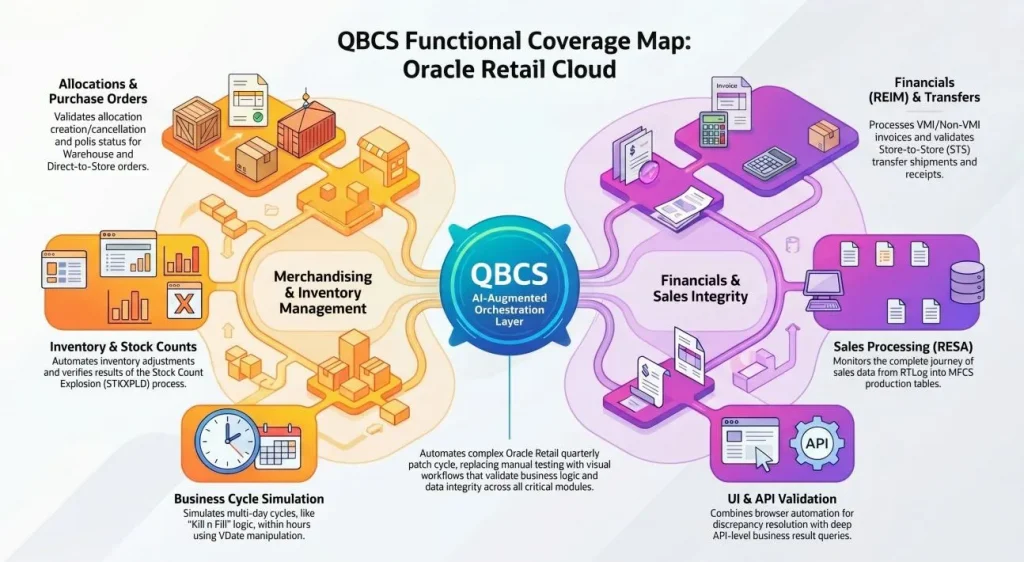
Our framework provides deep technical coverage across the Oracle Retail suite, integrating with 3rd Party applications like POM, Airflow, Mulesoft and Databricks etc. for every scenario.
Category and Technical Scope & Associated Systems
- Allocations: Creation (via RDS custom REST APIs), Cancellation, Shipment, and Receipt validation.
- Purchase Orders: Warehouse (WH) POs and SIM Direct-to-Store (DTS) POs; includes order status polling in MFCS.
- Inventory: SIM and WMOS Inventory Adjustments; Stock Count Explosion (STKXPLD) and result verification.
- Financials (REIM): VMI/Non-VMI invoice processing. Features Playwright-based browser automation for manual discrepancy resolution in the UI.
- Transfers: Store-to-Store (STS) Transfer creation, shipment, and receipt validation.
- Sales Processing: RESA sales data validation; monitoring the journey from RTLog to MFCS.
Engineered for Resilience: Stress and Business Cycle Simulation
Beyond functional checks, the tool is built for high-scale retail operations:
- Volume/Stress Testing: Validates the system’s ability to handle massive payloads, such as an allocation containing 1,000+ items, monitoring for API timeouts or database contention.
- Business Cycle Simulation: A major differentiator is the tool’s ability to manipulate the System Date if necessary. This allows the framework to simulate a multi-day business cycle- in exception based scenarios for Direct to Store Purchase Orders—within a matter if hours, rather than waiting for real-world days to pass.
- End-to-End Stack Validation: The tool verifies data integrity across the entire journey: from OCI/Azure Landing Zones to Databricks Raw tables, through Airflow
transformations, and finally into MFCS production tables.
The Business Value: From Weeks to Hours
By implementing the QBCS n8n framework, retail executives transition from reactive
firefighting to proactive assurance:
- Speed of Regression: Full suites that previously took an entire sprint now execute
overnight and unattended. - Reduced Risk: Catch regressions within hours of a patch being applied to a nonproduction environment, long before they hit your stores.
- Forensic Efficiency: Move from “forensic log sifting” to AI-driven reporting that
highlights exactly where a chain of dependencies broke. - Accessibility: Empower Business Analysts and PMs to trigger tests via natural
language, reducing the bottleneck on senior technical resources.
Conclusion: Your Next Patch as a "Tuesday Morning Message"
The quarterly Oracle patch cycle does not have to be a source of organizational dread. With QBCS AI automation, the “fire drill” is replaced by a simple automated notification on a Tuesday morning: “273 tests passed. One failure flagged in REIM discrepancy resolution. Here’s the technical root cause.”
Don’t wait for your next update to discover what’s broken. Reach out to QBCS today for a comprehensive Test Coverage Audit. We will map your integration topology and implement a resilient, AI-augmented framework tailored to your Oracle Retail Cloud environment.