
Stop Re-Testing Manually After Every Oracle Patch
Quarterly Oracle Retail Cloud updates shouldn’t mean weeks of manual regression work. Here’s how QBCS rebuilt end-to-end test automation with n8n and AI agents – turning a painful quarterly ritual into a one-click workflow.
Four times a year, or more, depending on which solution retailers have, Oracle pushes a mandatory patch to every Oracle Retail Cloud tenant. QA teams at retailers worldwide face the same daunting question: did anything break? Across merchandise planning, allocation, replenishment, and store operations, the answer requires testing hundreds of interconnected flows – most of which touch third-party event streaming platforms, data pipeline orchestrators, and Oracle’s own REST APIs simultaneously.
For most retailers, the answer to that question has been the same: a sprint’s worth of manual testing, brittle Python scripts, and crossed fingers. QBCS set out to change that – and the tool they built around is one you may not have considered for enterprise QA.
The Problem: A Chain of Dependencies Held Together by Scripts
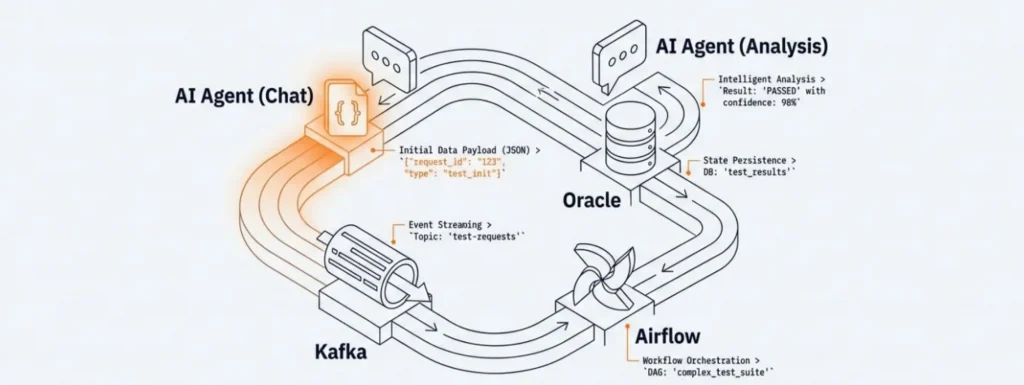
Modern retail backends are not monoliths. A typical merchandise allocation test touches three distinct system layers: third-party event streaming platforms, pipeline orchestration tools, and Oracle Retail itself (for the business result). Historically, wiring these together for a test meant:
- Custom Python scripts producing test data payloads
- Manual API calls to trigger Airflow DAGs
- SSH tunnels into secured Oracle environments
- Cron jobs to poll for results – and hope they finished on time
The result was a test suite that was brittle and hard to maintain, produced slow feedback loops (often measured in hours, not minutes), made error diagnosis a forensic exercise across multiple logs, and was nearly impossible for non-developers to understand or modify.
The Solution: n8n as a Visual Test Orchestration Layer
QBCS’s answer is to replace the script tangle and implement n8n, an open-source, self-hostable workflow automation platform designed for technical users. n8n’s core proposition is simple: instead of writing integration logic as code, you compose it as a visual, node-based workflow — a living flowchart where every API call, data transformation, and conditional branch is explicitly visible.
Critically for a retailer operating Oracle Retail Cloud, n8n is self-hostable and API-first by design, with over 500 built-in integrations and a flexible HTTP Request node that can talk to any secured REST endpoint. It doesn’t replace developers — it empowers them to build, test, and iterate faster, with full auditability.
How the Workflow Is Structured
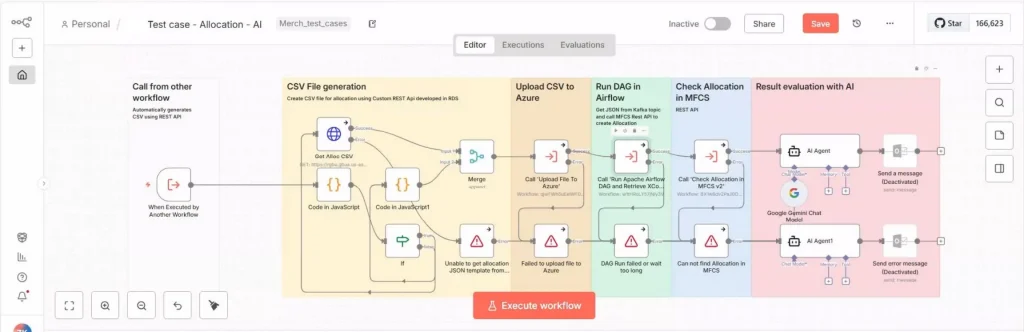
The QBCS automation blueprint follows five discrete legs, each represented as a visual section in the n8n canvas:
STEP 01: Trigger the Test
On-demand or scheduled; accepts natural language input via AI agent
STEP 02: Inject Data
Publishes a structured test message to the event streaming platform
STEP 03: Run the Pipeline
Triggers the integration pipeline orchestration and polls its status until complete
STEP 04: Query the Result
Fetches the processed allocation result from Oracle Retail via REST API
STEP 05: Assert & Report
AI agent validates outcome and sends a human-readable summary to the team
The AI Dimension: Two Agents, Two Roles
QBCS embedded two AI agents into the n8n workflow, each serving a distinct purpose that significantly amplifies the usefulness of the test suite.
Agent 1 – The Test Lead. This agent sits at the entry point of the workflow and is prompted to act as a QA Orchestrator. When a tester types something like “Run a stress test on allocation creation with 1,000 items,” the agent parses that natural language instruction into a structured JSON payload specifying test type, parameters, and scope. No form-filling, no script editing — just intent.
Agent 2 – The Analyst. After the test systems return their raw JSON results, a second agent transforms that data into a human-readable decision report: pass/fail status, average response times, SLO compliance, and actionable recommendations. What was previously a log file becomes a team briefing.
Real Output Example:
Status: PASS – The stress test completed successfully with a 100% success rate across 1,000 allocation items. Average response time was 120ms, well within the 200ms SLO. Recommendation: Monitor API latency during the upcoming holiday sale period.
Why This Matters Specifically for Oracle Retail Cloud
Oracle Retail Cloud operates on a quarterly patch cadence. Each update – covering functional enhancements, security fixes, and infrastructure changes – can silently affect behaviour across allocations, replenishment, pricing rules, and integration APIs. Retailers are contractually expected to validate their implementations after each patch.
Without automation, this means a QA team must manually re-execute every critical regression scenario across the full system stack – spanning event streaming platforms, pipeline orchestrators, and Oracle Retail itself – typically under time pressure before the next business cycle. At scale, across hundreds of test cases, this is a weeks-long exercise, every quarter, indefinitely.
With the QBCS n8n framework, the entire regression suite becomes a scheduled workflow run. The night after Oracle applies a patch, the pipeline fires automatically: it injects test data, triggers the relevant third-party pipeline tools, queries Oracle Retail, and emails the team a pass/fail report by morning – no human in the loop until a failure demands attention.
Business Value for Retailers
- Speed of Regression: Full end-to-end regression suite runs overnight, unattended. What took a sprint now takes hours.
- Visibility: Every workflow is a living flowchart. Non-developers — business analysts, PMs — can read and reason about the test logic without code.
- Accessibility: AI-powered natural language interface means QA engineers trigger tests with intent, not syntax. Lower barrier to test coverage expansion.
- Repeatability: Identical tests executed identically every quarter. No variance from manual error, staff turnover, or tribal knowledge loss.
- Risk Reduction: Regressions caught within hours of patching, before they reach production-impacting business processes like allocation or replenishment.
- Cost Efficiency: QA headcount is redirected from mechanical re-execution to high-value exploratory testing and new coverage. n8n is open-source and self-hostable.
Who Should Be Paying Attention
This approach is most immediately relevant for retailers running Oracle Retail Cloud at scale — particularly those with live third-party data pipelines feeding Oracle allocation or replenishment processes. If your QA cycle for a quarterly patch currently involves more than a few people for more than a few days, the ROI case for this framework is straightforward.
More broadly, any retail IT organization maintaining complex, multi-system integration stacks — where a change in one layer (an event streaming platform, a middleware API, a cloud service) propagates unexpectedly into business logic — benefits from moving from script-based testing to orchestrated, visual, AI-augmented automation.
The QBCS implementation demonstrates that the technology is production-ready. The n8n canvas is not a prototype environment — it is running live test orchestration across event streaming platforms, cloud file storage, pipeline orchestration tools, and Oracle Retail, with AI-generated reporting delivered directly to the team after each run.
The quarterly patch doesn’t have to be a fire drill. It can be a Tuesday morning Slack message that says: 1,247 tests passed. One failure flagged. Here’s why.
Getting Started
QBCS implements this framework as part of its Oracle Retail consulting practice. The engagement typically begins with a test coverage audit — mapping which integration flows are currently tested manually, which are untested, and which represent the highest business risk if broken post-patch. From there, the n8n workflow architecture is designed to match the client’s specific system topology.
Given n8n’s self-hostable, open-source nature, there is no vendor lock-in on the automation layer itself. The framework is owned by the retailer, extensible by their team, and deployable on existing infrastructure.
For retailers preparing for their next Oracle Retail Cloud quarterly update, the window to implement automated regression before that patch arrives is now.